luni, 14 ianuarie 2019

Sumerian influence on Aegean writing


From Sumer,Indus Valley, in Anatolia, Cyprus,Crete,Sicily,Sardinia to North America (northern Pacific coast indian tribes), the metal ingost had all-over in ancient times (Bronze Age ),the same physical shape:                                                                                                                              "OXHIDE"

From Who invented the oxhide ingot shape? Meluhha artisans. An archaemetallurgical journey along the Maritime Tin Route.                                                                               http://bharatkalyan97.blogspot.com/2017/04/who-invented-oxhide-ingot-shape-meluhha.html
                                                                           The large oxhide ingots were signified by ḍhālako a large metal ingot

From https://ipfs.io/ipfs/QmXoypizjW3WknFiJnKLwHCnL72vedxjQkDDP1mXWo6uco/wiki/Oxhide_ingot.html
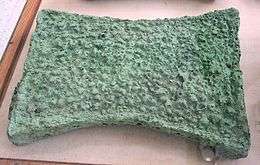
                                                                                                    Copper ingot from ZAKROS, Crete, displayed at the Heraclion, archaeological Museum.

1.IN THE FOLOWINGS, I WILL SHOW SOME SIMILIRATIES OF AEGEAN SIGNS WTH THOSE SUMERIAN-ONES; such relation was noticed also not so succesfully I expecte by Iannis Kenanidis and Evangelos Papakitsos.
2. Following the transmission of meaning is another matter. Early after proto-cuneiform phase the sumerian writing evolved as one sign do add other meanings that original pictographic-one. At the point that the original meaning was lost even by sumerians!    So, if signs were transmitted, one reasonable expect, that only the shape was some-how mantained, no talking that in another distant place (Aegean) to acquire another, different meaning. So, regarding the meanings I only notice some aspects, (in the limits of my understanding), not sustain an transmition of meaning.                                                        =======================================================
First Tartaria-sumerian Aegean triplet:
From http://aplaceofbrightness.blogspot.com/2008/11/moonlight-in-romania-tartaria-tablets_21.html


1.<metal ingot?<Pr-cuneif, sign KU < 2.KU:"metal,silver,shiny" >                                                    3.Aegean sign JA and PA3 

1.https://cdli.ucla.edu/tools/signlists/protocuneiform/archsigns.html  Sign KU~a

sign Ga2;

INDUS SCRIPT , http://bharatkalyan97.blogspot.com/2013/04/bronze-age-glyphs-and-writing-in.html                                                                                                                              
 "Impressions of two cylinder seals (Sumer) and glyph of 'ingot'. The person at the feet of the eagle-winged person carries a (metal) dagger on his left-hand, clearly demonstrating the link with this metalware catalog.Note the one-horned bull below the person who has his foot on mountain-summit.    Sumerian sign for the term ZAG ‘purified precious’. The ingot had a hole running through its length Perhaps a carrying rod was inserted through this hole.
"

From http://bharatkalyan97.blogspot.com/2016/04/indus-script-16-inscriptions-with.html
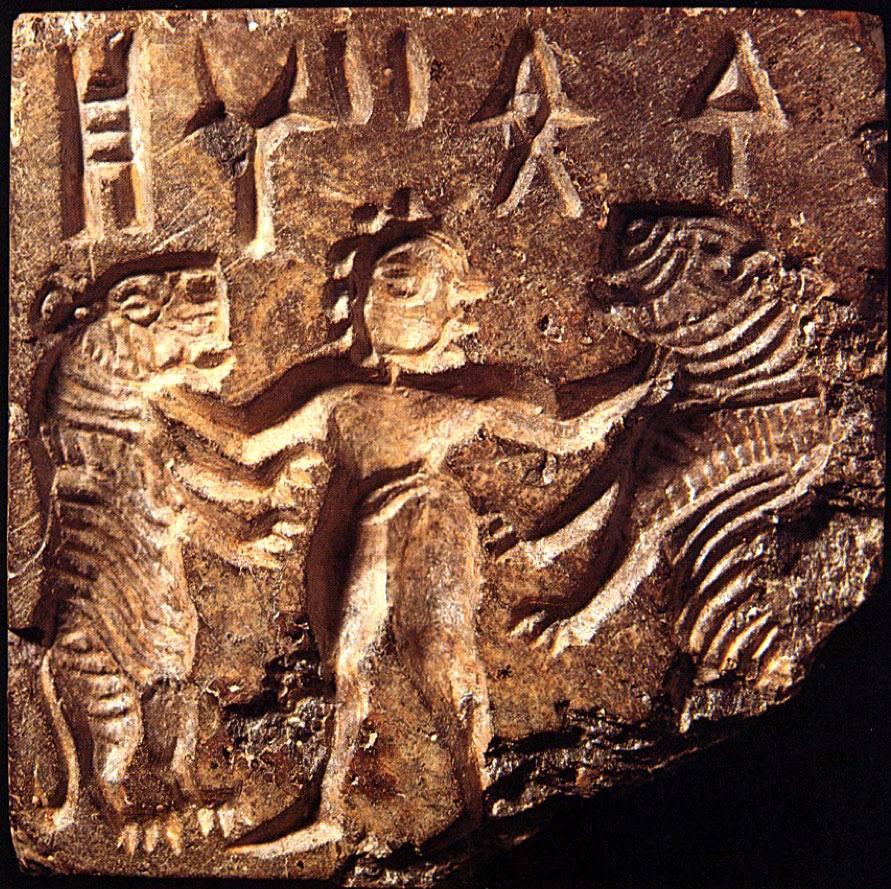

Seal stamp m-308 Mohenjo-daro (DK 11794) Hieroglyph: Three strokes connecting two linear strokes: dula 'two' Rebus:dul 'cast metal' PLUS kolmo 'three' Rebus: kolimi 'smithy, forge' Thus forge for cast metal

3. From http://www.kairatos.com.gr/linear1.htm See signs JA and PA.
.  
 
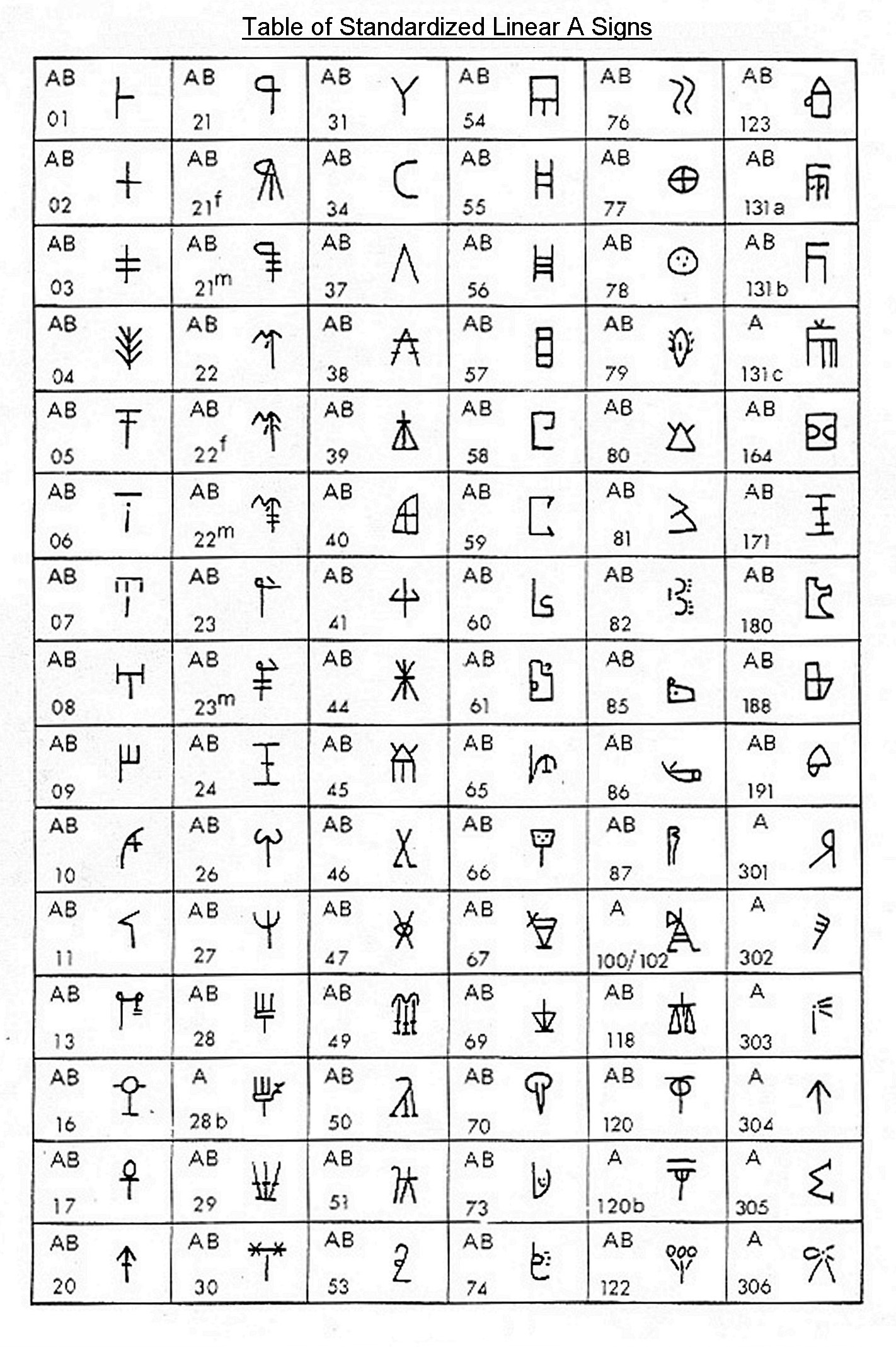
From https://www.minoanatlantis.com/End_Minoan_Writing.php                                                     See Linear A sign AB56:                                                                                       
----------------------------------------------------------------------
http://www.oocities.org/proto-language/ProtoLanguage-Monosyllables.htm                             K?A                                                                                                                                            The Sumerian sign (Jaritz #458) depicts a 'tubular basket'; a variant, #458a, tapers toward the top; both have top-covers; both presumably and read ga2 (among others). Another recorded reading for it is pisan, which means 'basket' but perhaps also '*shallow tray'.

An archaic variant form for Sumerian sign above (Jaritz #458), Jaritz #458a, looks very much as if it could be the 'head' without the hair and neck we see in Jaritz #15 under K?XA; and therefore might be a sign for 'jaw'; but it also may be just another shape of 'basket'. As mentioned below under K?XA, the most promising prospect for 'jaw' in sumerian is GA14, a reading of Jaritz #15 that is currently without an assigned meaning. I believe the the idea of 'jaw' provided the prototype and nomenclature for a 'shallow basket tray' but there is no trace of this meaning ('jaw') for this Sumerian sign
======================================================================== ========================================================================
Second Tartaria-Sumerian-Aegean triplet:
                                                     See in the lowest row, from L>to> R: 2-nd and last signs
1.sum.pr-cuneif sign ZAG < 2.sum.ZAG:"the shine of metals; boundary, border, district', " > 3.Aegean sign A,Labrys,?Labyrinthos?
  1. From https://cdli.ucla.edu/tools/signlists/protocuneiform/archsigns.html                        Sign ZAG~a 
and sign ZAG~c  sign GA'AR:

 GA'AR= GAR                                                                                                                                       From https://cdli.ucla.edu/files/publications/cdlj2012_002.pdf                                                         The sign GAR was used, thus, in order to denote all cereal products counted bisexagesimally, that is, virtually all barley
product rations except beer.

2. Akkadian called Sumerian - Sumerian Dictionary - Turkic World s155239215.onlinehome.us/turkic/.../SumerDictionaryEn.ht...                                          SUMERIAN DICTIONARY. Links ... Common Sumerian words for magical purposes ..... Holy of Holies, BARAGGAL ... Metals, ZAG (the shine of metals).

Sumerian Lexicon - IS MU https://is.muni.cz/el/1421/jaro2013/PAPVB_13/um/.../Halloran_version_3.pdf            (derives from zag, 'boundary, border, district', just as þúb relates to gùb). zeþ[SAL.ÁŠ.
3.
From https://sites.google.com/site/raghavg602/economic-life                                                     see Cretan hieroglyphic signs 042 and *175
From https://linearbknossosmycenae.com/tag/labrys/

So this shape could reflect:
                                                                                                                                                               the shine of metals > double-axe.labrys, but also
boundary,border,district> place of  the other underground sumerian's Sun,NERGAL                             

and at Aegeans, the place of Minotaur , in fact place of Sun-Bull-God (labyrinthos)
Proto-cuneiform sign for house, temple "AB" has the close sign: https://cdli.ucla.edu/tools/signlists/protocuneiform/archsigns.html


https://en.wikipedia.org/wiki/Nergal                                                                                      
Nergal seems to be in part a solar deity, sometimes identified with SHAMASH, but only representative of a certain phase of the sun.

Minotaur - Wikipedia https://en.wikipedia.org/wiki/Minotaur                                                               In Greek mythology, the Minotaur is a mythical creature portrayed in Classical times with the ... In Crete, the Minotaur was known by the name Asterion, a name shared with Minos' foster-father.   .........   Some modern mythologists regard the Minotaur as a solar personification and a Minoan adaptation of the Baal-Moloch of the Phoenicians.
He dwelt at the center of the Labyrinth
Asterion ; Greek: Ἀστερίων, gen.: Ἀστερίωνος, literally "starry") or Asterius /Ἀστέριος)

http://www.unmuseum.org/minot.htm                                                                                        However, they have found what looks like a labyrinth. The labyrinth wasn't built in a cave below the palace, though. It was the palace.
labbyrinth, in fact was somebody's house: "house,temple" =====================================
This is Mr. Kenanidis and Papakitsos aproach:
So Mr. Kenanidis and Papakitsos, no double-axe !, even the sign is like, see above "signify all barley product rations"                         ================================================================
Apropos of above sign 57 (Linear B LA32),                                                                                    (Only sumerian -Aegean:
sumerian GA2 <> Aegean JA Sumerian sign GA2~a3                                                                     from : https://cdli.ucla.edu/tools/signlists/protocuneiform/archsigns.html

vineri, 11 ianuarie 2019

11 jan.’19/Two main (until now) remained unclarified issues regarding Tartaria tablets

11 jan.’19/Two main (remained unclarified) issues regarding Tartaria tablets

Later on, I realised that two fundamental issues regarding Tartaria tablets remained unclarified:

The suposition that the tablets are not (by far) so old, and could be made later than innitialy was supposed.

I advanced before the hypothesis about an recent origin of the tablets.          ( As a posibility in a time contemporaneous with the scientist Zsofia Torma, and maybe later ). I will show that this hypothesis is not fesable, cause: – Before 1900 the proto-writing field and research  was quite empty, there were not only very few researchers and research papers on the subject. Even now-days the research it is in a continous progress (see proto-Elamite, Dahl, Englund).  There were very few schollars at the level of A.H.Sayce, in Zsofia Torma’s time.                                                                                                          From https://en.wikipedia.org/wiki/Archibald_Sayce                                              "Archibald Henry Sayce (25 September 1845 – 4 February 1933), was a pioneer British Assyriologist and linguist, who held a chair as Professor of Assyriology at the University of Oxford from 1891 to 1919"
                                                                                   
Even A.Falkenstein (born after the death of Z.Torma) only later got a sumerian proto-cuneiform sign list, notice, without giving any corespondent meanings or interpretations to signs,

From https://en.wikipedia.org/wiki/Adam_Falkenstein                                   “Adam Falkenstein (September 17, 1906 – October 15, 1966) was a German Assyriologist. Falkenstein studied Assyriology in Munich and Leipzig. He was involved primarily with cuneiform, particularly discoveries in Uruk, and with the Sumerians and their language. From 1930 onward, Falkenstein taught as a professor of Assyriology at the Göttingen University."

The tablets are revealing complex aspects, I would say even “sofisticated”-ones wich are reflecting a relation between Near-East and Aegean cultures. This complexity is depassing the medium level, as even an now-days specialist, practically cannot easy show this  with a now-made written tablet as exemple.  So, the suposition that somebody contemporaneous had tried and made such tablets as a kind of exercise, is falling down. “                       ------------------------------------------------------------------------------
Beware, here I distance myself from the main schollar’s path, wich are talking only of “A relation at some degree of Tartaria tablets signs with proto-sumerian writing”.
I am stressing that the scribe was not “their literate/intelectual”, but but “ours”,meaning by this that was not native sumerian, but rather somebody settled in Danubian/Aegean area, even if we don’t bother that was of sumerian descendance or not, and totally disregarding how old would be.
The aspect sized by no others, only by me, that the signs on Tartaria tablets are common to two great civilisations, Sumerian and Aegean and a icons of paramount cultural importance for them.           
This very aspect was not sized nor revendicated by others before I mentiond first. The schollars limited only to notice the similarity with sumerian proto cuneiform writing and so, forced to interpret the “writing” within these limits. 

 Exemple of such papers:
                                                                    
A Comparative Linguistic Study about the Sumerian Influence on the Creation of the Aegean Scripts Ioannis K. Kenanidis1, Evangelos C. Papakitsos*2 
file:///C:/Users/User/Downloads/SJAHSS-31E332-346%20(1).pdf                                                     
Additional Palaeographic Evidence for the Relationship of the Aegean Scripts to the Sumerian Pictography    file:///C:/Users/User/Downloads/SJAHSS-33C734-737Additionalevidence.pdf                                                                     
In these papers, many exemples (sign-pairs) by far are not the best choosen-ones, not much convincing (and regarding sumerian signs there are not shown their sumerian name nor what signify or the meaning.)                                          
Linear B,sign"A"(labrys) with sumer."double axe", where sumerian sign is no "double-axe", it is sum. sign ZAG, wich not signify double-axe; then sum.AMAR it is not correct associated. 

Only in the last paper there are some few correct associated.
Corect assoc. :Lin.B(LA32)"JA", then sum.Se with Egeean Te....and that's all. Of course because probably was not their goal, no reference to Tartaria tablet's signs.
          
 Eg., only some SIGNS COMPARED by me:

Sumerian                Aegean

  GAR               VOLUME UNIT       (Egypt, T,"loaf of bread" )               SE                         TE                              Cereal,grain                        AMAR                      MA                                                                        Y                            Y                                                                         KU                         PA3                                                                       AB                     LABRYS                                                                      PA                         PA                                                                           etc                        etc                                                                        ------------------------------------------------------------------------ 

II.The suposition (otherwise corect) that the upper half of the round tablet is containing kind of willingly hidden, or esoteric message.

Yes, more than possible. But from wich period of time, and why to be hidden, especially what could be the nature of the message !?
Here, the presence of one sign wich is not be found even in Aegean writings (nor in eteo-Cretan-ones) is (pitty) conducting us to the archaic greek writing.
It is about the well-known “D-letter” shaped sign

In the upper half of the round Tartaria tablet, only the Aegean signs Pa3(arch. Gr.Eta), sign “o” and some-how the sign “+++++” seem to existed before, and sign D appeared only in the first regional/epichoric archaic greek alphabets.                           
This fact is pushing us away from an before-supposed extremely old period, to one much new-one, 800-300 years B.C. 

And now, what could be written there?                            
Note                                                                                                    1.One don’t expect necessary an continous message as in a sentence, there could be isolated icons wich had/has independent meanings (but pertain to an single solid religious unit) . T an complex system of notions and values.           
2. I did not know before, there are even sentences wit only 2 words! ———————————————————————————
Even some years before, I found that the oldest atestation in writing of the “HP” monogram, was found on some broken pot clay sherds, in some places, (probably at the origin from, or related to Samos), much more outside Greece, in the Levantine coast and Egypt.

You understand from “HP”,: “archaic eta-Rho”, where archaic eta was in the shape of “boxed-eta”, meaning closed contour, or with some earlier shape, “eta/heta a scala” meaning in the “ladder” shape.
Scholars are opinating that this sequence was abbreviation for (monogram of):
                      1.Hera                                                                                                     2.Heros (Hero)                                                                                         3.proper name Heros. Same me saying.
Cause :                                                                                                      – The oldest Aegean deity was at the origin Vinca mother-goddess followed by later minoan Asasara and Ida-mater,/Damater, and aftyerwards by Dione,                                                                        
– Hera somehow is preceding Zeus,                                                            – Complex nature of the Hera’s role and etymology,                                    I put on first place Hera, and only close-after an supposed Heros.           (remember that both Horus as Heros were kind of people saviors, Christ precursors)

From http://www.crystalinks.com/hera.html                                                                       ”Unlike some Greek gods, such as Zeus and Poseidon, Hera’s name is not analyzable as a Greek or Indo-European word. She therefore seems to be a survival of a pre-Greek “great goddess” figure – perhaps one of the powerful female divinities of the Minoan pantheon, or of some unidentified pre-Greek (“Pelasgian”) people.

From https://ro.wikipedia.org/wiki/Hera#Etimologie                                    ”Una dintre primele instanțe ale numelui zeiței apare pe tablele din Pylos, scrise în Linear B,un sistem de scriere care a fost găsit și pe datând încă din 1450 IHr folosit de civilizațiile miceniene până la colapsul acestora în secolul XII iHr. Aici apare ca Qo-wi-ja (Guōwiā „cea asemenea vacilor” un cunoscut epitet homeric.]
Numele Herei poate avea mai multe etimologii se exclud reciproc; o explicație leagă numele de ὥρα transliterat hōra, însemnând sezon, interpretându-l ca o vreme propice pentru căsătorie. Pe de altă parte, Platon consideră că e legat de ἐρατή transliterat eratē, adică „preiubit”, deoarece se spune că Zeus s-a căsătorit cu ea din dragoste, sau că numele zeiței este anagramă a aēr (ἀήρ, „aer“).Plutarh susține a doua variantă sugerând că este un nume alegoric pentru poziția înălțată a acesteia.”
nonsense…

From https://en.wiktionary.org/wiki/%E1%BC%AD%CF%81%CE%B1#Ancient_Greek  
”HERA EtymologyUncertain. Possibly a feminine form of ἥρως (hḗrōs) or related to ὥρα (hṓra).”
garbage! I am binding the Hera’s name out of “protecttress”, also to: er,era:”EaRth” ,hiera:”holy” and hera “Lady” !!

From https://www.etymonline.com/word/hera                                             ”sister and wife of Zeus, the type of virtuous womanhood, from Greek Hēra, literally “protectress,” related to hērōs “hero,” originally “defender, protector” (see hero(n.1)).”

11Ian'19/ Clarificarea a doua aspecte fundamentale privind Tablitele de la Tartaria

Ulterior am realizat ca urmatoarele aspecte necesita o revenire si clarificare:

I. Supozitia ca tablitele nu sant nici pe departe atat de vechi si au fost facute ulterior. 

Am avansat anterior ca ipoteza o origine relativ recenta a tablitelor. Cum ar fi in perioada de activitate a Zsofiei Torma si chiar ulterioara. In buna masura aceasta ipoteza nu se sustine, intrucat:     - Inainte de 1900 domeniul scrierii proto-cuneiforme nu era aproape deloc cercetat.Foarte putini cercetatori de talia lui A.H.Sayce, contemporani cu Zsofia Torma erau in acea vreme.
https://en.wikipedia.org/wiki/Archibald_Sayce                                                                           Archibald Henry Sayce (25 September 1845 – 4 February 1933), was a pioneer British Assyrologist and linguist , who held a chair as Professor of Assyriology at the University of Oxford from 1891 to 1919                                                                                   Chiar si Falkenstein (nascut dupa moartea Zsofiei T.) de-abea mai tarziu a scos lista semnelor proto-cuneiforme, nedand nici-unui semn vre-o interpretare.
https://en.wikipedia.org/wiki/Adam_Falkenstein                                                                 Adam Falkenstein (September 17, 1906 – October 15, 1966) was a German Assyrologist Falkenstein studied Assyrology in Mubich and Leipzig. He was involved primarily with cuneiform, particularly discoveries in Uruk, and with the Sumerian and their language . From 1930 onward, Falkenstein taught as a professor of Assyriology at the Gottingen University.
Tablitele prezinta aspecte complexe, as zice eu chiar "sofisticate" care reflecta o relatie intre culturile Orientale si cea Aegeeana. Aceasta complexitate depaseste nivelul mediu. ca atare nici macar un specialist in zilele noastre, nu ar putea sa reflecte ( a se citi sa imite) aceste legaturi. Deci supozitia ca cineva relativ contemporan ar fi facut un gen de incercare, cade.                                                ------------------------------------------------------------------------------------
ATENTIE
Un anume aspect  nu a fost sesizat de altii, ci numai de mine, si anume ca semnele de pe tablitele de la Tartaria sant comune a doua mari civilizatii, cea sumeriana si cea Egeeana, iar icoanele au fost de o importanta culturala covarsitoare in aambele civilizatii.
. Semnele doarau legatura cu cele sumeriene si de fapt apartin preistoriei Europei in general si celei Vinca si Egeene in particular. Aceasta observatie nu a fost revendicata de nimeni pana acum.Savantii s-au limitat la a face doar legatura cu semnele sumeriene proto-cuneiforme si a le atribui interpretarea sumeriana ! Deci fara ca sa depaseasca aceste limite.   
     Exemple de asemenea lucrari:                                                                                                         A Comparative Linguistic Study about the Sumerian Influence on the Creation of the Aegean Scripts Ioannis K. Kenanidis1, Evangelos C. Papakitsos*2 file:///C:/Users/User/Downloads/SJAHSS-31E332-346%20(1).pdf                                                                                                             Additional Palaeographic Evidence for the Relationship of the Aegean Scripts
to the Sumerian Pictography    file:///C:/Users/User/Downloads/SJAHSS-33C734-737Additionalevidence.pdf                                                                                                               
In aceastea, foarte multe exemple nu sant fericit gasite, nu sant convingatoare si nici prea concludente, iar in privinta semnelor sumeriene nu este data denumirea sumeriana si nici semnificatia lor.Doar in ultima lucrare sant cateva asocieri relativ corecte :                                                       Linear B,"A"(labrys) cu sumer."double axe" cand semnul sum. nu este nici-o dubla-secure, este semnul ZAG;C,apoi sum.AMAR nu este bine asociat. Corect asoc. :Lin.B(LA32)"JA", apoi sum.Se cu Egeean Te....si cam atat. Bineinteles, posibil pentru ca nici nu si-au propus, ca nu apare nici-o ref. la tablitele de la Tartaria.                                                                              

 Ex., doar cateva  SEMNE COMPARATE de mine:

Sumerian               Aegean

  GAR                    UNIT de VOLUM       (Egypt, T,"loaf of bread" )                                                         SE                         TE                              Cereale-boabe,grau                                                                 AMAR                   MA                                                                                                                               Y                              Y                                                                                                                           KU                         PA3                                                                                                                             AB                     LABRYS                                                                                                                            PA                         PA                                                                                                                                 etc                        etc                                                                                                                              -------------------------------------------------------------------------------      

II. Supozitia (altfel corecta) ca jumatatea de sus a tablitei rotunde contine un "mesaj" intentionat ascuns.
Da, mai mult decat posibil.Dar din ce perioada, de ce ar fi fost ascuns, si mai ales de ce natura ar fi putut fi !?
Aici, prezenta unui semn care nu se regaseste nici macar in scrierile Egeene (nici macar scrierea eteo-Cretana nu poate intra in discutie) ne conduce din pacate spre perioada scrierii arhaice grecesti.            Este vorba despre semnul "D". In jumatatea de sus a tablitei rotunde doar semnele Egeean PA3 (arh. grec eta) si "o"au existat, in schimb semnul "D" nu a aparut decat doar in primele alfabete grecesti.
Acest fapt ne indeparteaza total de o presupusa perioada extrem de veche (3.500-3.000 B.C.) si ne indreapta direct spre perioada 800-300 B.C.   Totusi ar mai ramane o sansa infinitesimala ca semnele D sa reprezinte asa cum in scrierea minoana semnul pentru unitate de volum este foarte apropiat de un D.Ar putea fi vorba in acest caz de o varianta de scriere locala.
-------------------------------------------------------------------------                                                                           Acuma ce ar putea fi scris acolo ?  

 Atentie, aici ma indepartez de cursul acceptat al oamenilor de stiinta, care fac o directa legatura cu scrierea sumeriana.                                                                                                                         Eu zic ca autorul "scrierii" nu a fost  literatul"lor" , ci al nostru, adica din aria Egeana/Dunareana, aceasta independent de faptul  ca ar fi fost mai vechi sau mai nou.       Aspectul sesizat ca semnele sant comune unor mari civilizatii, Sumeriana si Egeeana nu a fost sesizat si nici revendicat de altcineva inaintea mea. Cercetatorii s-au limitat la o interpretare facand doar legatura cu civilizatia sumeriana.                                                                                                                                                 ---------------------------------------------------------------------------------------------------------                                Inca acum cativa ani, am gasit cea mai veche atestare a asociatiei de semne "HP" a fost gasita pe bucati de artefacte din lut in Grecia si poate mai multe in Orientul Apropiat si Egipt. Sa intelegeti prin "HP" archaic eta-rho. Adica arhaic eta sub forma "boxed/cutie" adica cu contur inchis sau forma "in scarita".                                                                                                                    Cercetatorii au avansat ipoteza ca arfi monograma sau prescrtarea pentru Hera sau Heros. La fel zic si eu. Avand in vedere ca se pare ca                                                                                                             - zeitatea Hera il precede cumva pe Zeus, si avand in vedere:                                                             -lunga perioada anterioara de venerare a unei zeite Pamant-Mama (Earth Goddess), dar si natura complexa a numelui Hera, eu dau intaietate lui Hera ,urmat indeaproape de un eventual Heros. (A se retine ca Heros a fost un gen de erou salvator precursor a lui Cristos)
https://ro.wikipedia.org/wiki/Hera#Etimologie                                                                                   Una dintre primele instanțe ale numelui zeiței apare pe tablele din Pylos, scrise în linear B un sistem de scriere care a fost găsit și pe datând încă din 1450 iHr, folosit de civilizațiile miceniene până la colapsul acestora în secolul XII iHr. Aici apare ca Qo-wi-ja (Guōwiā „cea asemenea vacilor” un cunoscut epitet homeric.]
Numele Herei poate avea mai multe etimologii se exclud reciproc; o explicație leagă numele de ὥρα transliterat hōra, însemnând sezon, interpretându-l ca o vreme propice pentru căsătorie. Pe de altă parte, Platon  consideră că e legat de ἐρατή transliterat eratē, adică „preiubit”, deoarece se spune că Zeus s-a căsătorit cu ea din dragoste, sau că numele zeiței este anagramă a aēr (ἀήρ, „aer“).[3] Plutarh susține a doua variantă sugerând că este un nume alegoric pentru poziția înălțată a acesteia.[4]
aiurea...      https://en.wiktionary.org/wiki/%E1%BC%AD%CF%81%CE%B1#Ancient_Greek   EtymologyUncertain. Possibly a feminine form of ἥρως (hḗrōs) or related to ὥρα (hṓra).[1][2]
varza! eu leg numele de era:"pamant" ,hiera:"sfanta" si hera "doamna" !!

marți, 8 ianuarie 2019

Tartaria tablets signs compared or Tartaria tablets, sign by sign

Tartaria tablets signs compared, or                                     Tartaria tablets, sign by sign

OUT OF SOME OUTSTANDING INTERPRETATIONS THROUGH SUMERIAN (A.A.VAIMAN and RUMEN KOLEV),                                                                                                                          

AFTER SOME YEARS OF RESEARCH, A CLEAR IMAGE IS EMERGING:                               MANY SUMERIAN PROTO-CUNEIFORM SIGNS HAS EQUIVALENTS IN SHAPE IN AEGEAN WRITINGS.                                                                                                                                           AS MR. RUMEN KOLEV  FIRST NOTICED AND MADE SUCH ATTEMPTS,                              I FOUND ALSO MUCH MORE SIMILARITIES AND CULTURAL RELATIONS,       ( BETWEEN NEAR-EAST AND AEGEAN AREAS ) AS BEEING ABLE TO DEDUCE/EXTRACT AND SHOW YOU MANY MORE AND CLOSE -RELATED MEANINGS.                                                                                                                                          

IT IS ABOUT OF PARAMOUNT IMPORTANCE, (COMMON IN AN EXTENDED AREA) ICONS, WITH THE ORIGIN FAR BACK IN TIME. =============================================

More or less, almost all the signs could be fount in exact shape or as a sqetch the sumerian proto-cuneiform signs. But some of them reflect the exact shape of the signs from later writings. 

Where the signs has the exact shape of a writing,I will mark with*.

Round tablet’s signs (R)

https://encrypted-tbn0.gstatic.com/images?q=tbn:ANd9GcSoHnmGyZZHx37HuCFCpYRgIJdQxE5vuc7vcNlb00JtKMccyZpjqA

All-three-have-symbols-inscribed-only-on-one-face.-Photo-Credit-640x480

No1. sign "+++++"                                                                                                  

 No.2.1 sign :1-st "D"                                                                                                                      

No.2.2: 2-nd "D"                                                                                                                            

 No.2.3, sign"o"                                                                                                                             

No.2.4, sign"o/c"?                                                                                                                               

SEgrid

No.3 sign: Downward-Right quarter,  on the right                                                                   

cristian_luchian_tartaria_tablets

No.4, sign:Downward-right quarter,  on the left (red)                                      

SWgrid

No.5. sign "Z-like"lower sign                                                                                 

No.6/left, sign "bow&arrow"                                                                                                      No.6/up, sign ">>"                                                                                                                        

The-meaning-if-any-of-the-symbols-is-unknown.-Photo-Credit-640x480

No.7, sign "H"-like                                                                                   

No.8,sign "P/D"-like

Squarred tablet’s signs (Sq):

https://encrypted-tbn0.gstatic.com/images?q=tbn:ANd9GcTGmJn6uRzrDVyluR0qaLWHqYbn2UJsQbNcrjbnze7I27mP1riVZg
fig-202

Table in wich is showed every sign in wich writing was found in exact shape and most frequent:

Note:”Anatolian, means mostly Carian)

Tabl.  Sign No.    Most frequent  2-nd frequecy

R             1                               Sum.*,Anat.
R           2.1                     Anat.,Arch.Gr.*.Old.Lat.*
R           2.2                     Anat.,Arch.Gr.*.Old.Lat.*
R           2.3                Sum.*Anat.*Aegean*,Arch.Gr.*
R  2.4.(“o”/”c”?)     if "o": Anat.*,Aegean*; if "c" Anat.,Arch.Gr.*,Old Lat.*
R           3                        Sum.* 
R           4                           None
R           5(Z-like)             Sum.,Anat.*,Aegean*,Arch.Gr.*,Old.Hebr.*
R    6(left,"bow-arrow")                  Sum.,Anat.
R     6(up,">>")                             Anat.*
R          7                     Aegean*,Old Hebrew*
R          8                  Old Hebrew*,Arch.Gr.*,Old Lat.*                                                                               ---------------------------------------------------
Sq         1                          Sum.*
Sq         2                         Sum.*,Anat.
Sq         3                     Sum.*,Anat.,Aegean
Sq         4                        Sum.*,Anat.
Sq         5                      Sum.,Cypr.
Sq         6                  Sum.*,Aegean*
Sq  above 7            (Anat.elements, Aegean?)
Sq        7                         Sum.*

If every sign< pair >type of writing  has 1 point, then, out of 20 signs,number of signs found in the writings:

Sumerian  12    ************
Anatolian  11    ***********
Aegean      6 ******
Arch.Gr.   6 ******
Old Hebr.  3 ***
Cypriot    1 *
Old Lat.   4 ****

NOTE

1. IF the tablets are genuine show a direct/great sumerian influence/inspiration (11 sumerian-like signs)

2. After sumerian , much plausible is Aegean writing ( sumerian close-influenced) 

3.Signs "D" were used by sumerian only before 3.200 B.C., but very few and only on the ext. surface of clay tokens (bullae) with unknown meaning.                                                                      It seems due the fact that were put in the recipients column on proto-sumerian signs table, could be for "pot,jar,vessel",                 ?measure-ration?

4. Otherwise the D-shape was not used after in writing 2.500 years till archaic greek writing,(3.200-2.500=700)

5. .The "H'-sign                                                       http://aplaceofbrightness.blogspot.com/2008/11/moonlight-in-romania-tartaria-tablets_21.html

NWgrid
has the exact phoenician/old hebrew (Cheth/Het) shape
58537889_m


and only close to Aegean (PA3) writings .Linear A sign PA3 has no shifted vertical bars , as our sign and Old Hebrew is.                                                                   Image from https://linearbknossosmycenae.com/tag/linear-a-decipherment/page/2/
ht-88-kikina-01-datare-figs
P.S.Capital old Hebrew and Phoenician "het" and  is identical with archaic greek Heta(boxed eta) and 

Imagini pentru letter archaic eta

sumerian proto-cuneiform "Ku" (Number 3,first)

6. Sign ">>" found only in Anatolian (Carian ) writing

7. I DO NOT EXPLAIN MYSELF, 
HOW EXACTLY THE UPPER HALF OF THE ROUND TABLET, SUPPOSED COVERED/HIDDEN CONTAIN MOST MODERN SIGNS.                      

 POSSIBLE THIS WOULD BE THE ONLY SECTION OUT OF ENTIRE BOTH TABLETS WICH CONTAIN AN DIRECT READABLE MESSAGE

WHAT KIND COULD BE? MILITARY SECRET NO !, ESOTERIC, RELIGIOUS-MYSTIC ?.                                                                                               YES, COULD BE THE CASE.


8.DON'T KNOW WHAT SCRIBE WOULD MIX (real name "hodge-podge"), PICTOGRAPHIC SIGNS WITH IDEOGRAMS SYLLABOGRAMS ! =========================
OUT OF SOME OUTSTANDING INTERPRETATIONS THROUGH SUMERIAN (A.A.VAIMAN and RUMEN KOLEV),                                                                                                                          

AFTER SOME YEARS OF RESEARCH, A CLEAR IMAGE IS EMERGING:                               MANY SUMERIAN PROTO-CUNEIFORM SIGNS HAS EQUIVALENTS IN SHAPE IN AEGEAN WRITINGS.                                                                                                                                           AS MR. RUMEN KOLEV  FIRST NOTICED AND MADE SUCH ATTEMPTS,                              I FOUND ALSO MUCH MORE SIMILARITIES AND CULTURAL RELATIONS,       ( BETWEEN NEAR-EAST AND AEGEAN AREAS ) AS BEEING ABLE TO DEDUCE/EXTRACT AND SHOW YOU MANY MORE AND CLOSE -RELATED MEANINGS.                                                                                                                                          


IT IS ABOUT OF PARAMOUNT IMPORTANCE, (COMMON IN AN EXTENDED AREA) ICONS, WITH THE ORIGIN FAR BACK IN TIME.